
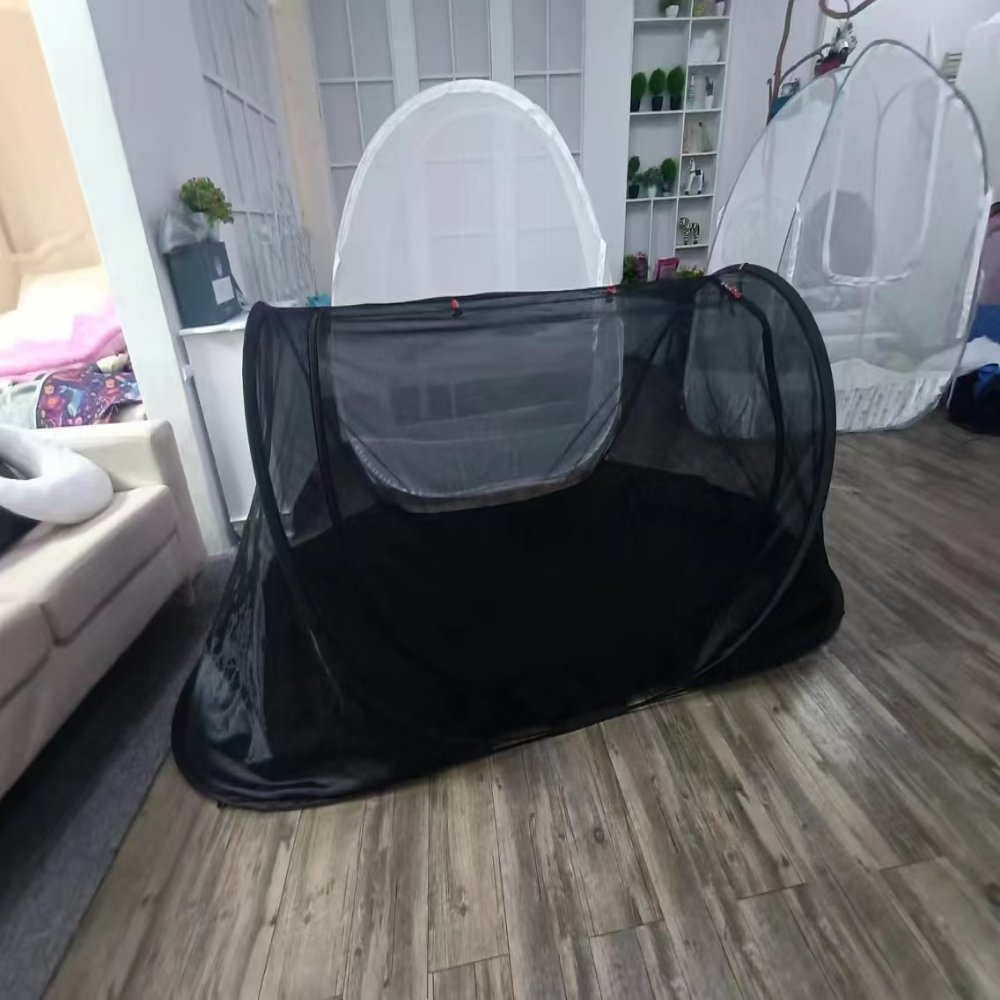
Before comparing cot tent offers, separate the tent enclosure from any cot, support or loose component that may be supplied with it. Ask for a written list tied to the exact sample and quotation. A catalogue title using the word cot does not prove that an elevated bed or a complete sleeping system is included in the quoted product.
Ask what the catalogue name represents
Kangna lists a Folding Camping Cot Tent in its outdoor tent category. The official photograph shows a dark tent enclosure displayed on a floor. That is enough to identify a catalogue reference for an enquiry, but it does not demonstrate an included elevated cot. The product page’s wording should be clarified with the supplier before the buyer describes the offer as a combined bed and tent.
Start the request with the exact product link and ask the supplier to identify the item being priced. If the proposed supply is the enclosure alone, record that explicitly. If a cot or another support is offered, request a separate reference for it and a statement of whether it is included, optional or supplied by another party. Do not let one convenient product name replace that distinction.
Create one line for each supplied component
Build a component schedule that can be used by purchasing and receiving. Name the enclosure first, then ask the supplier to list any support, carrying item, loose fitting or instruction material included in the proposal. These are questions about the actual offer, not a claim that those components are present. A blank or pending field is safer than inventing an expected accessory from a display image.
When a component has its own reference or revision, keep that information beside its line. Ask whether the sample package contains the same components that will be covered by the quotation. If something is supplied only to help demonstrate the sample, mark it as a demonstration item. Receiving staff should not need to inspect marketing photographs to decide whether a package is complete.
Component line | Question to resolve | Record required
Tent enclosure | Which exact item is quoted? | Catalogue and sample references
Cot or support | Included, optional or not supplied? | Separate item identity and scope
Loose components | What belongs to this offer? | Itemised list and quantities
Carrying or packing item | Supplied with sample and order? | Confirmed packing reference
Instructions | What documentation is proposed? | Actual document or pending status
Keep compatibility separate from inclusion
Even if an enclosure and a support are both available, that does not establish that a particular pair is compatible. Ask the supplier to identify the proposed combination and explain how it should be assessed. If your team intends to use an existing cot or platform, provide its reference and relevant drawing rather than asking the seller to infer the setup from a short product description.
Define the sample review around the proposed combination, including how it is arranged and which interfaces need checking. Do not create a load rating, stability claim or user-safety conclusion from an appearance check. Any required test or suitability assessment should be identified separately and supported by appropriate evidence for the actual proposed items. A component list answers what is supplied, not every question about how it performs.
Use sample photographs to verify identity
Request photographs that link the full enclosure and any separately offered components to their sample identifiers. A general display photograph may help your team recognise the product family, but it cannot establish the contents of every package. If the supplier proposes a revised enclosure or another support, ask for an updated list and clearly marked images rather than accepting an unlabelled replacement.
Check the packing proposal against the same component schedule. Ask which parts are grouped together and how separate items will be identified. If different packages are proposed, record their relationship to the order line so the receiving team can reconcile them. Do not assume that a tent shown in an arranged state will arrive in one package, or that a carrying item mentioned in descriptive text is included without confirmation.
• Keep the enclosure and any cot or support on separate supply-list lines.
• Connect each proposed component to a sample identifier and quotation reference.
• Mark demonstration items and optional items so they cannot be mistaken for included supply.
• Reconcile the packing proposal with the approved component schedule before ordering.
Approve the offer without adopting unsupported claims
The catalogue contains statements about setup, privacy and protection. Those statements are not independently verified here and should not be copied into an order as tested performance. If your intended use requires a specific outcome, describe it and ask the supplier for item-specific evidence. A floor display of the enclosure cannot establish elevated use, insect exclusion, weather resistance or load capability.
Finish the review with a written scope statement covering the offered item, approved sample references, component list and packing proposal. Keep unresolved compatibility, instructions and performance requirements visible. This allows the buyer to compare offers on the same supply basis while preserving the distinction between a product family name and a confirmed complete system. It also gives the supplier a precise list of remaining decisions instead of a broad request to confirm everything.
Frequently asked questions
Does cot tent necessarily include a cot?
No. Ask the supplier to identify the exact quoted supply and give any cot or support its own component reference. The catalogue title alone does not settle inclusion.
Can one approved photograph replace the packing list?
No. Use photographs to support item identification, then obtain a written component and packing list tied to the quotation and sample references.
What if an existing cot will be used?
Provide the actual cot reference and relevant requirements, then ask about the proposed pairing. Do not infer compatibility, stability or load capability from a catalogue appearance.
Product and contact references
Catalogue reference: confirm matching item: https://knplaytents.com/product/folding-camping-cot-tent/
Related catalogue reference: https://knplaytents.com/product/pet-tent-2-piece-set/
Contact Kangna Playtents: https://knplaytents.com/contact/
Kangna Playtents blog: https://knplaytents.com/blog/